
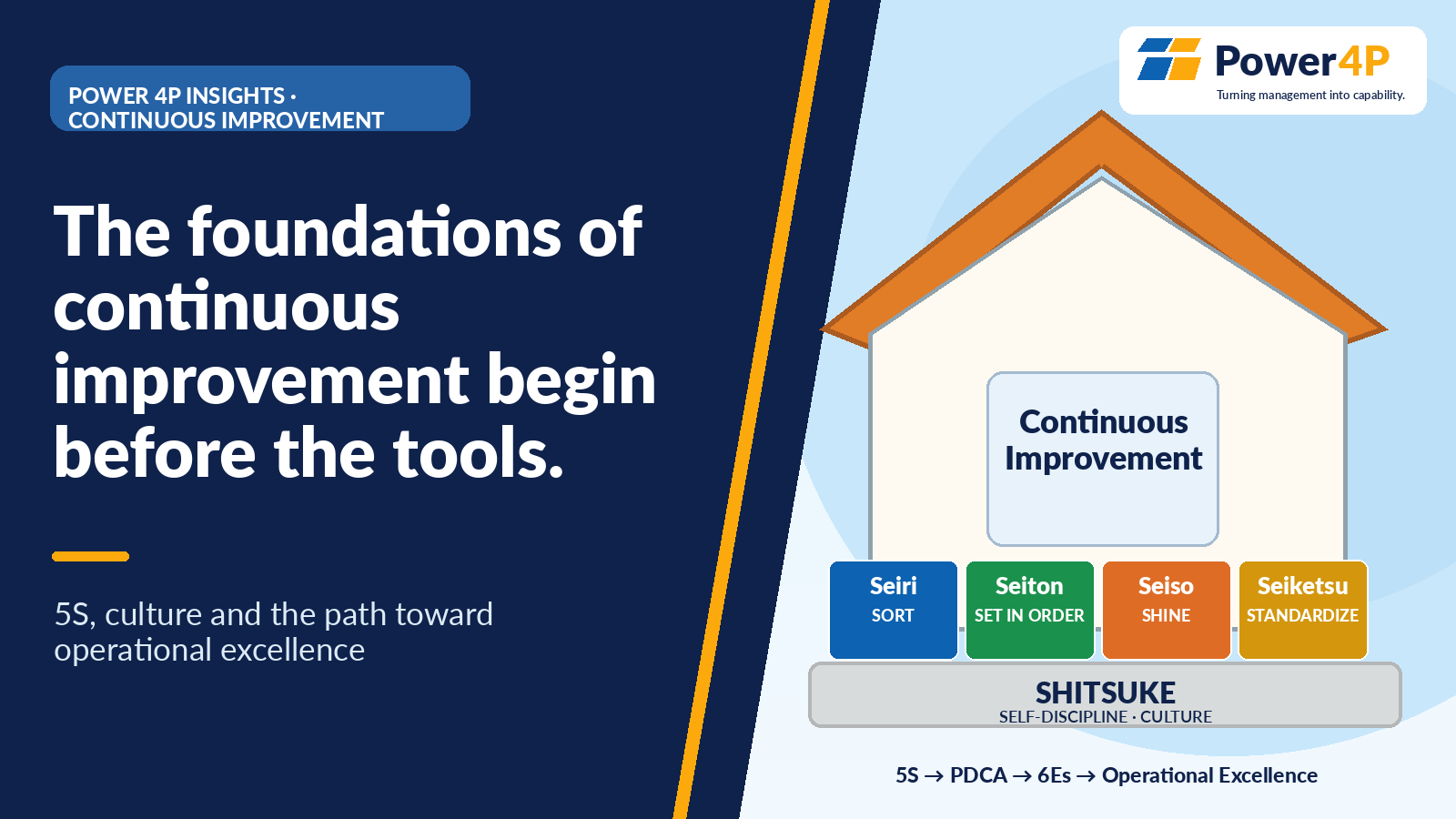
You don't build a house by starting with the roof
Imagine a company that decides to invest in continuous improvement.
Leadership sets new goals. Teams look for technologies, dashboards, metrics, and methods that can increase productivity, reduce costs, and improve quality.
Expectations are high.
Yet when changes begin, difficulties emerge that should have been addressed earlier.
Information is scattered. Procedures are unclear. Departments apply different criteria. Some processes depend heavily on individual knowledge, and seemingly simple situations require unnecessary effort.
The company wants to build something new without yet understanding the structure on which it plans to build.
It is like putting up the walls of a house before preparing its foundations.
Before we change a reality, we need to understand how it works.
This is where 5S takes on a meaning far broader than its usual association with tidiness and cleaning.
A simple method that can reveal a great deal about an organization
5S is a Japanese approach based on five practices that help create more organized, functional, and suitable working environments.
You may have seen its traditional illustration: five elements shown as parts of the same whole.
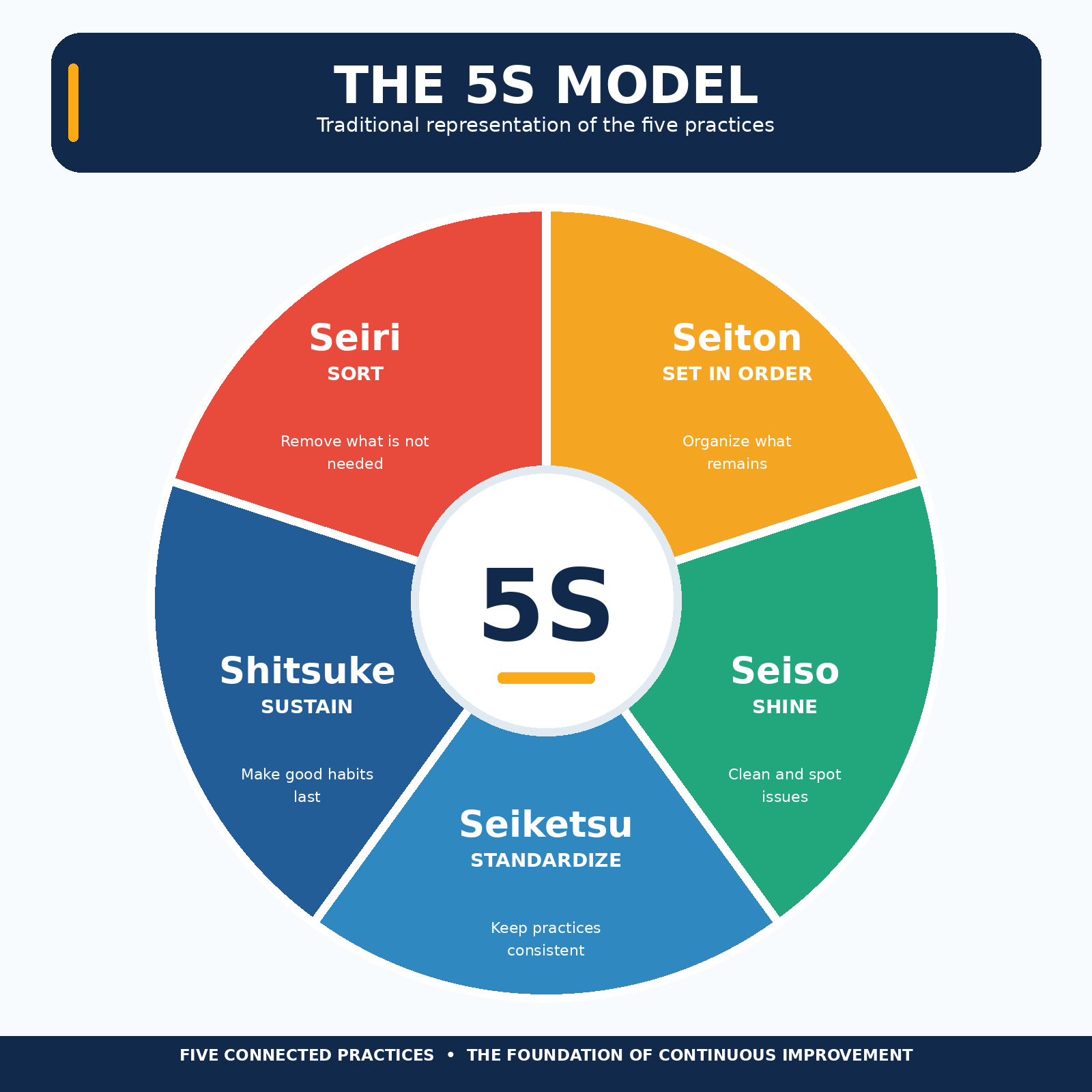
At first glance, the method appears simple.
And its principles really are easy to understand.
What many organizations underestimate is the depth of change possible when these principles stop being one-off activities and start guiding the way work gets done.
Consider a company in which customer orders travel across several departments before they are fulfilled and invoiced.
There are duplicate documents, parallel tracking systems, outdated information, and difficulties finding important records.
The first move is to look at what exists and understand what truly needs to remain.
That is Seiri, or Sort. Separating what is needed from what is not does not mean throwing things away indiscriminately. It means asking what contributes to the work, what creates waste, and what no longer serves a purpose.
Next comes organizing what remains.
Seiton, or Set in Order, establishes places, identification criteria, and access arrangements that make activities easier to carry out. This applies to physical tools, documents, digital information, and other process resources.
Then comes Seiso, or Shine.
Beyond removing dirt, it encourages care for the work environment and awareness of abnormalities. In an office, for example, it can reveal obsolete files and unsuitable working conditions. In an industrial setting, it can help expose leaks, wear, and recurring sources of contamination.
With Seiketsu, or Standardize, these conditions gain clear reference points. People understand how to organize, maintain, and perform activities, reducing reliance on improvisation and individual interpretations.
These four practices create important conditions.
But they do not, by themselves, ensure those conditions will last.
That is where Shitsuke, self-discipline or Sustain, comes in.
Its contribution deserves to be understood as more than the fifth item on a list.
Understanding the AS IS means knowing the ground before building
In process management, two expressions are widely used: AS IS and TO BE.
AS IS describes the current state: how activities actually happen, who participates, how information flows, and where delays, waste, failures, and improvement opportunities appear.
TO BE describes the desired future state: how the process should work after the proposed changes.
Between those two states lies a transformation journey.
And that journey should not begin with assumptions.
Let's return to our example company.
Before redesigning order fulfillment, we need to understand its real workflow. What data is received? Who checks it? Where do duplicates arise? Why does certain information have to be entered again? Which activities genuinely contribute to the outcome?
An AS IS assessment helps us see that reality.
And this is where an important connection with 5S emerges.
Just as Seiri starts by examining what exists and distinguishing the necessary from the unnecessary, process assessment requires understanding the current situation before deciding what should change.
Seiton helps organize resources and information.
Seiso develops awareness of abnormalities.
Seiketsu helps establish standardized operating conditions.
5S and AS IS/TO BE process mapping are not the same method. But they share an essential logic: understand reality, identify what needs to change, and build better conditions for work.
This connection makes 5S especially useful when preparing environments and routines for continuous improvement initiatives.
The first four practices build the base. Shitsuke consolidates the structure.
Let's return to the construction of our house.
A foundation is not simply a collection of elements placed side by side.
Its components need to work together so the structure has continuity and stability.
This is the metaphor we propose for understanding the five practices from a cultural perspective.
The first four help build the base: assess what is needed, organize resources, care for existing conditions, and establish standards.
Shitsuke is the integrating element that consolidates that construction.
In Power 4P's proposed visual interpretation, self-discipline surrounds the other practices.
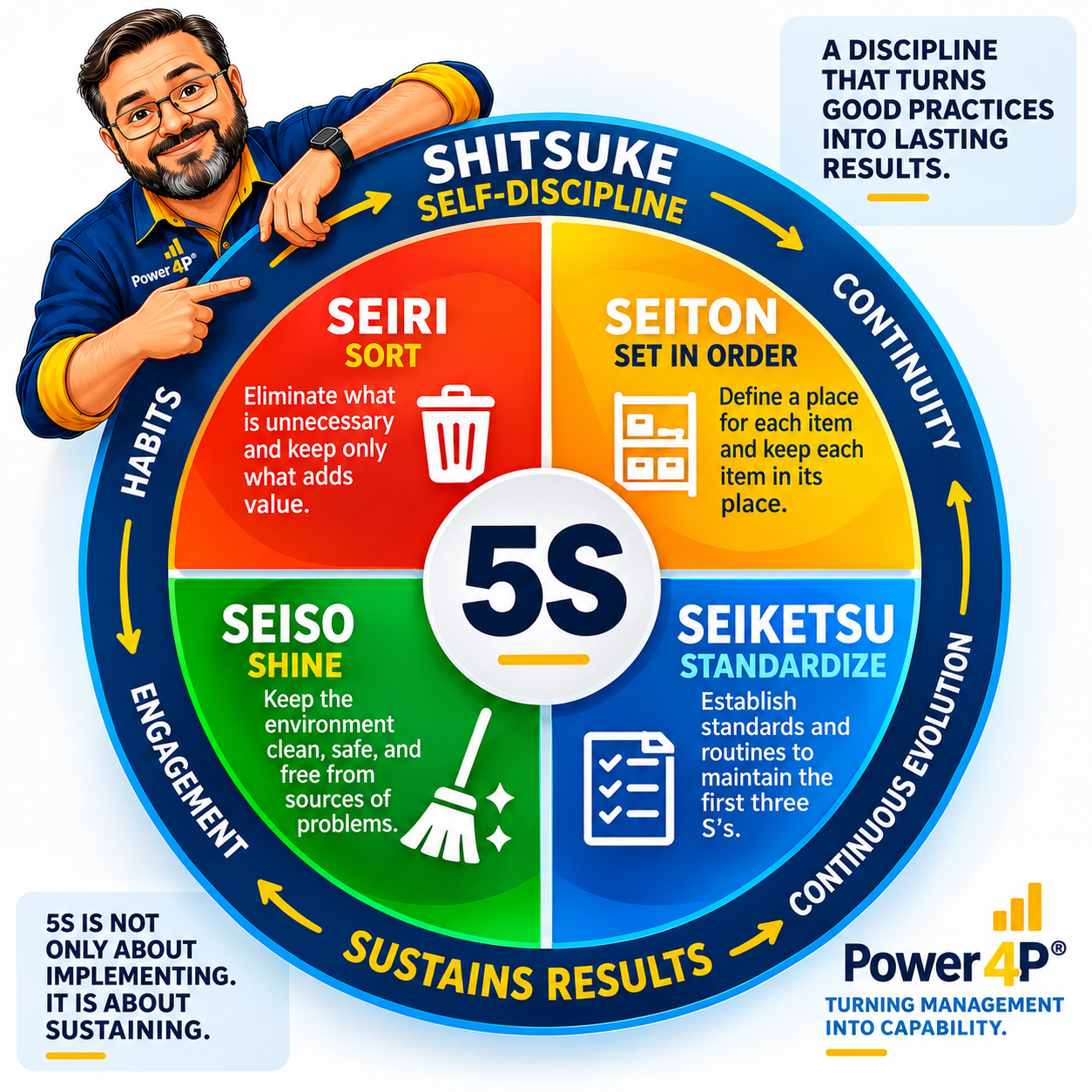
If we take the building metaphor a step further, Shitsuke can be represented as the concrete that surrounds, binds, and provides cohesion to the foundation's components.
Not because the other four are less important.
But because good practices existing in isolation do not ensure they will remain part of everyday work.
Seiri, Seiton, Seiso, and Seiketsu help structure working conditions. Shitsuke helps consolidate them into consistent behaviors.
That is the central thesis of our interpretation.
The fifth practice remains part of 5S, but its role cannot be reduced to the final task in an implementation.
It represents the continuity needed for the conditions already built to become stable and part of organizational culture.
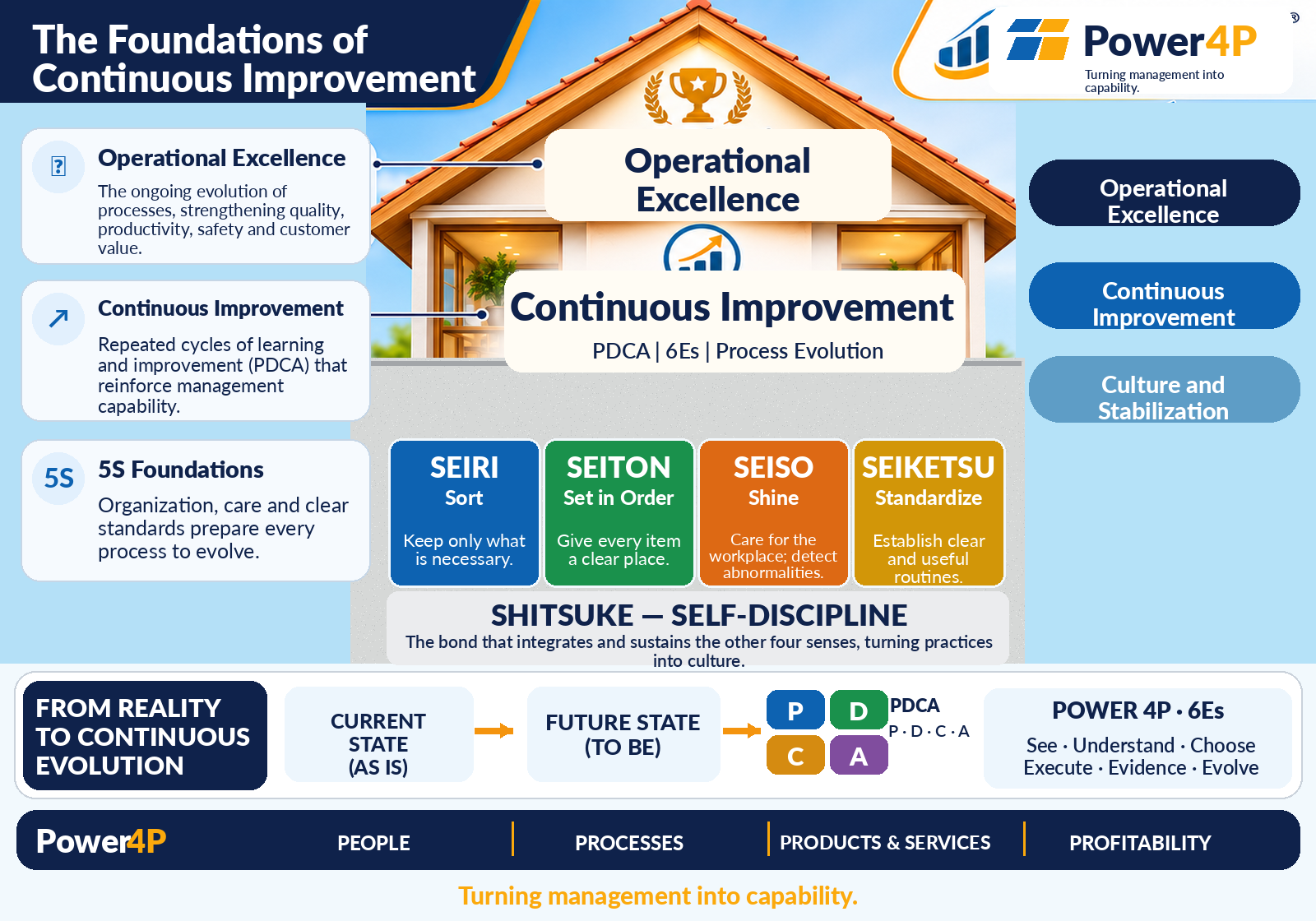
Stability creates the conditions for progress
An improvement needs to produce results.
But it must also make those results understandable, measurable, and sustainable.
Imagine that our company has redesigned its order management process.
It now has clear order intake criteria, standardized information, defined responsibilities, and mechanisms for identifying inconsistencies.
The new workflow represents the intended TO BE.
Yet a process diagram does not guarantee that the process will work as planned.
The company will need to implement the changes, monitor results, address deviations, and adjust standards.
This is where stabilization becomes an essential part of continuous improvement.
It does not mean preventing further changes.
It means building a reliable reference point so the organization can recognize when something improves, when something deteriorates, and when another intervention is needed.
An improvement that never stabilizes may force a company to confront the same situations it believed it had already solved.
By contrast, well-designed and sustained standards allow every new improvement cycle to begin from a more mature baseline.
The organization becomes less dependent on corrective action alone and develops a continuing capacity to learn and evolve.
But something must come before all this: the quality of decisions made before execution.
PDCA and the 6Es: different ways to guide progress
Once the foundation is established, continuous improvement must keep moving.
That is where PDCA fits.
Planning a change, carrying it out, checking its results, and acting on what has been learned form a cycle of improvement that can be repeated.
A standard built today can be improved tomorrow.
And every improvement adopted in daily work can become the reference point for the next cycle.
This dynamic also connects with Power 4P's management framework, the 6Es:
ENXERGAR — SEE: observe reality without assuming that every problem is already understood.
ENTENDER — UNDERSTAND: examine causes, relationships, constraints, and consequences.
ESCOLHER — CHOOSE: select courses of action using criteria, priorities, and awareness of available resources.
EXECUTAR — EXECUTE: put changes into practice, involving people and facing actual implementation conditions.
EVIDENCIAR — VERIFY WITH EVIDENCE: distinguish impressions from facts, examining intended and unintended outcomes.
EVOLUIR — EVOLVE: learn from results, revise practices, and consolidate what has demonstrated value.
Notice how this logic runs through the entire construction described here.
It begins with understanding the current state, guides the desired future state, accompanies implementation, and remains present when results are assessed and standards evolve.
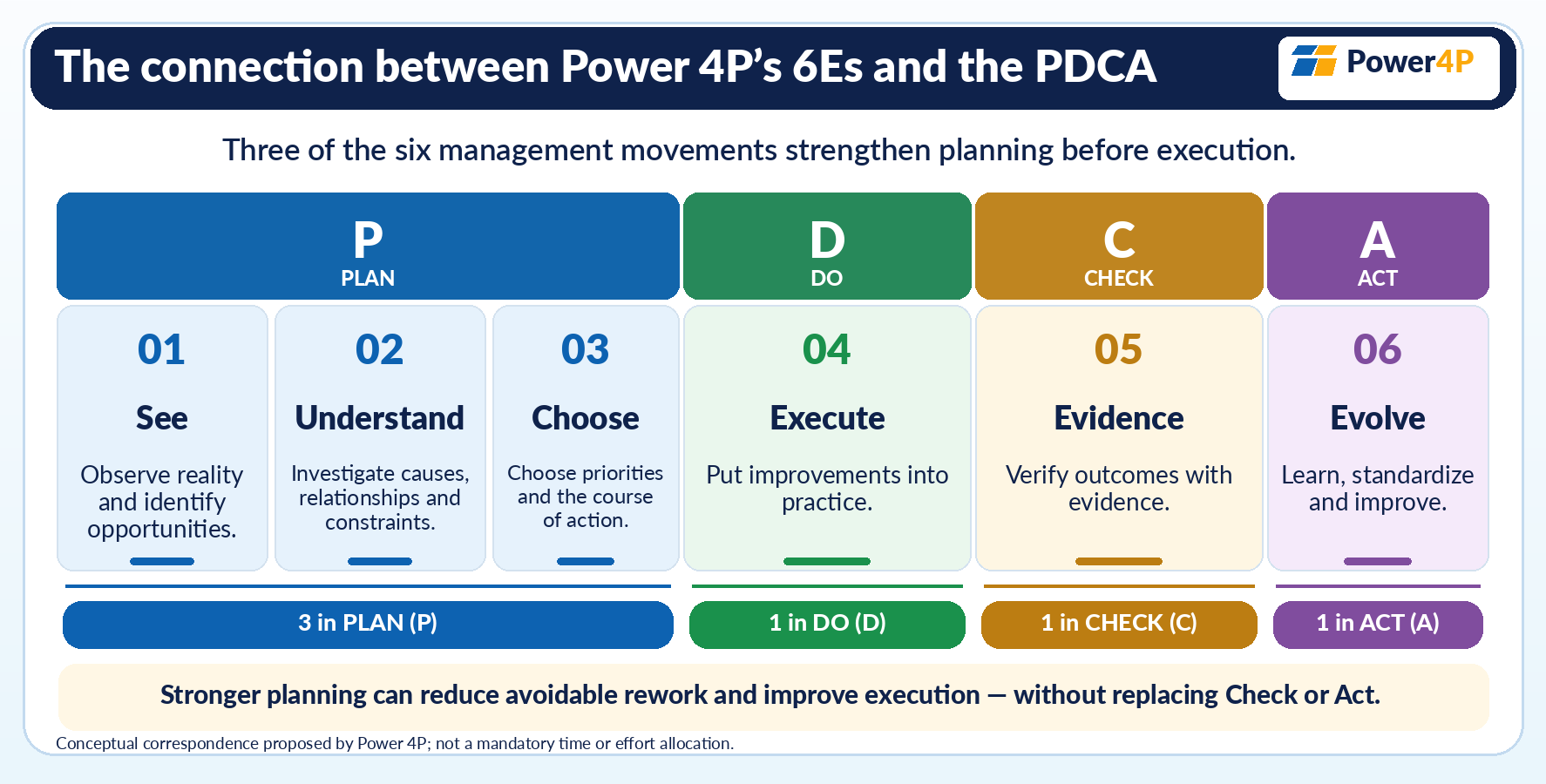
Three movements need to happen before execution
There is something in this relationship worth examining more closely.
When we view Power 4P's 6Es alongside PDCA, we see that three of the six movements — See, Understand, and Choose — focus on preparing what will later be executed.
They are closely related to P: Plan.
Before acting, we need to see reality.
Before proposing solutions, we need to understand causes, relationships, and constraints.
Before committing resources, we need to choose where and how to intervene.
These movements are not additional bureaucracy. They offer an opportunity to reduce hasty decisions, poorly sized interventions, and avoidable rework.
And the connection with foundations becomes even clearer.
We do not start a building by pouring concrete. First we study the ground, assess conditions, design the structure, and prepare the foundation that will support it.
Management follows a similar logic.
AS IS assessment helps us understand the organizational terrain.
TO BE design defines what we want to build.
5S helps organize the work and establish more reliable conditions.
And Shitsuke strengthens the continuity of the practices that support further progress.
Only then can we fully appreciate why planning is not simply the first step in a cycle, but an investment in the quality of every stage that follows.
Better planning for more consistent execution
This interpretation also raises a question about how PDCA is commonly illustrated.
Its four stages are often drawn as equal quadrants.
That representation is useful for understanding the cycle, but it does not mean management should assign equal time or effort to all four stages.
In some situations, understanding reality, examining root causes, and evaluating alternatives may require proportionally greater attention to planning.
That does not make execution less important.
Nor does it eliminate the need to check results and act on what is learned.
On the contrary.
More thorough planning can reduce preventable errors, improve resource allocation, and create the conditions for more effective execution.
The construction metaphor is useful again.
Paying close attention to the foundations does not mean valuing the walls or roof less. It means recognizing that the quality of the whole building also depends on the preparation of its base.
The same idea guides our view of continuous improvement.
We do not need to pit 5S, process mapping, PDCA, and the 6Es against one another. We need to understand how they can work together.
5S contributes practical and cultural foundations.
AS IS and TO BE help us understand and redesign processes.
PDCA guides cycles of change and learning.
The 6Es provide an integrated management perspective linking diagnosis, decisions, execution, evidence, and evolution.
If three of our six movements involve preparing for change, are we giving planning enough attention?
Perhaps balance in an improvement cycle is not about dividing effort equally among its stages, but about investing in the quality of decisions made before execution.
This question leads naturally to the topic of our next Power 4P Insights edition:
PDCA: does more planning mean less correction?
Culture is what remains when the project ends
There is an important difference between a company that has implemented 5S and one that has developed a culture of organization and improvement.
In the first, people may follow standards because a campaign is underway.
In the second, standards make sense and become part of the normal way of working.
This does not happen through imposition alone.
Self-discipline does not mean shifting all responsibility onto the people performing the work.
Leaders must ensure the right conditions, resources, training, participation, follow-up, and consistency between what they require and what they themselves practice.
If a team must constantly choose between meeting demand and following an impractical standard, simply demanding more discipline will not resolve the issue.
The standard itself may need to change.
Culture develops when an organization translates its expectations into real working conditions and consistently reinforces the behaviors it wants to sustain.
That is why Shitsuke deserves special attention in our metaphor.
It is not permanent surveillance of the other four practices. It is the consolidation of a way of working that people can understand, apply, sustain, and continuously improve.
From continuous improvement to operational excellence
The house we are building represents more than an organized area.
It represents an organization progressively developing its ability to function better.
Here we must also broaden the meaning of operational excellence.
Operational excellence is not limited to factory production, logistics, or activities traditionally labeled operations.
Every organization runs through processes.
Those processes include sales, finance, administration, technology, human resources, customer service, purchasing, planning, and much more.
When processes are understood, organized, measured, integrated, and continuously improved, an organization's management capability becomes stronger.
Reliable information in a finance process can improve decisions.
A well-structured hiring process can reduce rework and improve the candidate experience.
Standardized service, without losing necessary flexibility, can make customer experience more consistent.
An organized supply chain can reduce uncertainty and waste.
In each case, the principle is similar: understand reality, build suitable conditions, establish standards, monitor results, and evolve.
Operational excellence can be viewed as a level of maturity where this pursuit extends beyond isolated projects and begins to guide the integrated management of organizational processes.
It is not a destination reached once and for all.
It is a capability that must keep developing.
The construction never ends
Let's return to our house.
Well-built foundations allow new structures to be developed with greater confidence.
But they do not eliminate the need for maintenance, inspection, adaptation, and improvement.
Organizations work in much the same way.
5S can help establish initial foundations.
Shitsuke helps turn those foundations into culture.
AS IS assessment reveals current reality.
TO BE design helps guide transformation.
PDCA and the 6Es help conduct new cycles of learning and improvement.
And operational excellence emerges as an increasingly broad pursuit of quality and of the ability of organizational processes to produce consistent results.
The foundation of continuous improvement comes before the most sophisticated tools. It begins with how an organization learns to see, understand, organize, and sustain its own work.
Because implementing a tool may change a process.
Building culture is what enables an organization to keep improving long after implementation is over.