
The false choice that diminishes management
In many organizations, a question still arises, explicitly or otherwise: should we prioritize people or results?
The question sounds practical. But it starts from a flawed premise: that performance and the quality of relationships compete for the same space, as though demanding delivery necessarily meant increasing pressure and caring for people meant giving up targets.
Neither conclusion holds as a general rule. Organizations need goals, indicators, deadlines, and accountability. They also need people able to understand priorities, collaborate, learn, decide, and execute. The conditions in which people work affect those capabilities.
Before results, we must understand what connects people to work
There is a question that comes before many discussions of productivity: why would someone want to join this organization and, once there, why would they remain willing to build results alongside others?
Pay, working conditions, and career prospects are essential. But they do not provide the whole answer. People also bring values, interests, life plans, different ways of seeing the world, and expectations about the meaning of their contribution. The organization, in turn, must make clear why it exists, whom it serves, what commitments it makes, and what results it seeks to achieve.
When that conversation never takes place, a professional may know their job description and fulfill the assigned activities while remaining disconnected from the meaning of their work. The company may interpret this distance as a simple lack of motivation, when part of the problem lies in a lack of clarity about purpose and each person's role in the collective effort.
Attracting with purpose: the work begins before hiring
In my book Pessoas: A Arte de Atrair, Desenvolver e Encerrar Ciclos com Excelência [People: The Art of Attracting, Developing, and Closing Cycles with Excellence], I propose looking beyond filling vacancies when attracting professionals. Hiring someone with technical competence matters, but the conversation should not end with skills, duties, and compensation.
Attracting with purpose requires an honest account of the values actually practiced, working conditions, leadership style, development opportunities, and what the organization seeks to accomplish. It also requires listening to the professional: what do they value, what do they wish to learn, what motivates them, and what kind of contribution do they find meaningful?
This connection is not a similarity test or a filter for hiring people who agree with everything. An organization needs a diversity of backgrounds, perspectives, and ways of thinking. Relevant alignment does not mean absolute identity between personal and organizational purposes; it means enough compatibility to build shared commitments without erasing individuality.
Misalignment may also become visible through broken promises. A company that proclaims collaboration but rewards destructive competition between departments teaches something different from what it announces. Everyday experience tends to outweigh recruitment messaging.
Rather than asking only whether someone fits the job, we should also ask: does the organization offer real conditions for this person to find meaning, contribute, and grow here?
Belonging is more than being welcomed: it means having a place and a voice
Belonging is not simply being socially accepted or liking one's colleagues. It is recognizing that your presence makes a difference, that your contribution is taken seriously, and that you can help build results without having to hide questions, ideas, differences, or difficulties.
In Pessoas: Desenvolvimento com Intencionalidade [People: Development with Intentionality], I describe psychological safety as one of the foundations of belonging. People need room to ask questions, respectfully disagree, flag risks, and acknowledge mistakes. But belonging also involves recognition, fairness, trust in relationships, and consistency between what the company promises and what it practices.
Important distinctions remain: being welcomed does not release anyone from responsibility; being heard does not guarantee that every suggestion will be adopted; and respecting individuality does not mean abandoning shared goals. A healthy environment must be able to uphold those distinctions.
When people do not feel part of the organization, they may complete tasks without fully understanding or embracing their contribution. When they have room to participate, conditions are more favorable for bringing knowledge into play, identifying problems, and developing solutions. This does not ensure performance by itself, but it expands the capacity for collaboration and learning.
Which piece of the puzzle am I?
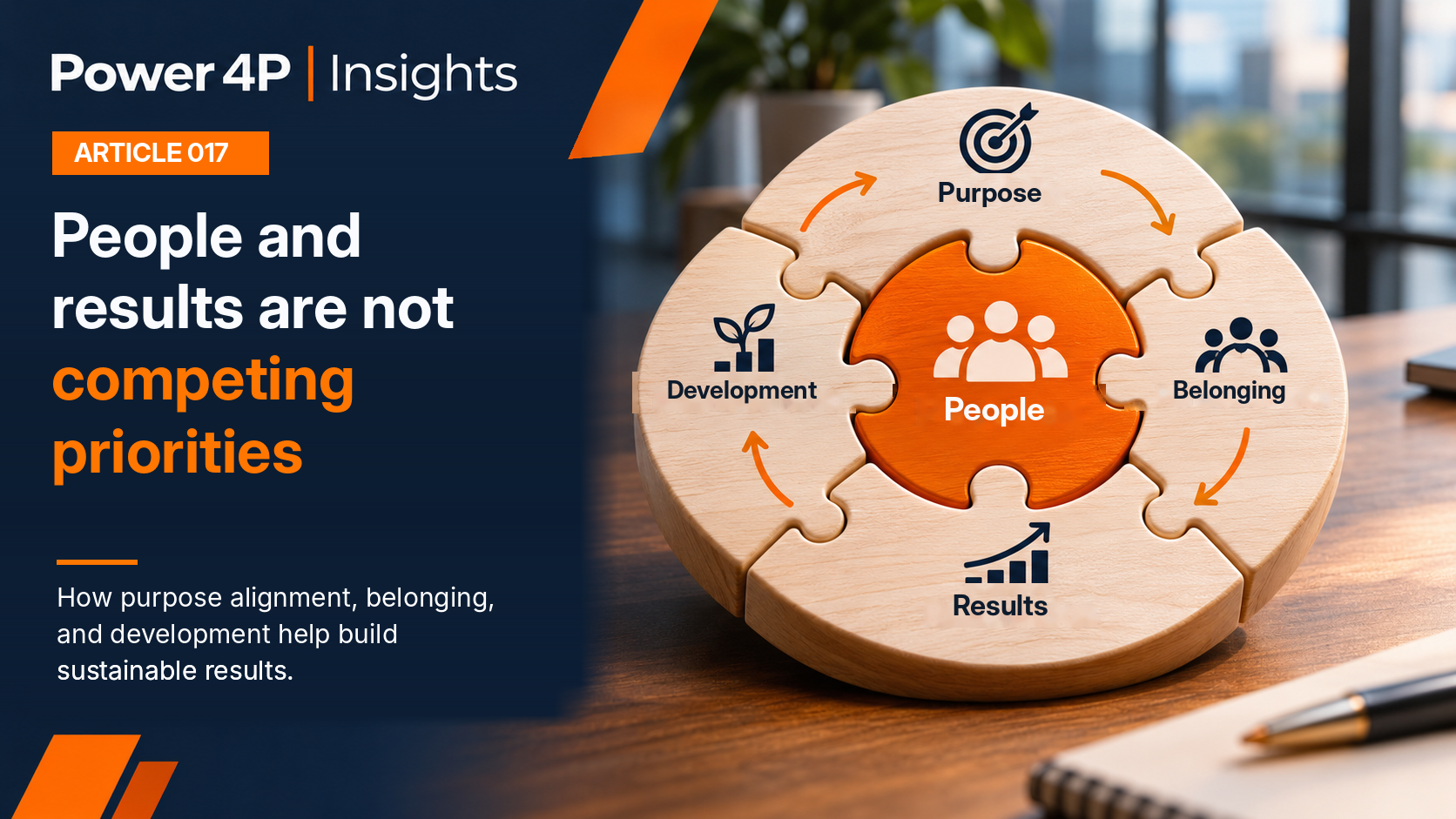
I often use a simple image to explain the connection between individuals and organizations: each person needs to understand which piece of the puzzle they are and how they can contribute to the whole.
A single piece has its own characteristics. Its shape, colors, and unique features do not disappear when it finds its place in the overall picture. On the contrary, each piece's distinct contribution is precisely what makes the larger image possible.
At work, that understanding goes beyond knowing the organizational chart. People need to understand who benefits from their deliverables, which other processes depend on them, how their work connects to strategy, and why the quality of their actions matters to customers, colleagues, and results. Leaders have a role in making those connections visible.
Consider someone who records operational information. If the activity is described only as filling in fields by a certain time, it may feel like bureaucratic repetition. When that professional understands that accurate records help another team plan resources, prevent rework, and serve customers better, they begin to see a broader contribution. This is an illustrative example, not an account of an actual case.
This does not mean every task will become enjoyable, or that purpose replaces decent pay, good conditions, or resources. It means that understanding one's contribution can give meaning to effort and improve conversations about priorities and responsibilities.
Purpose alignment must continue after hiring
Alignment is not a certificate granted during recruitment. People change. Strategies are revised. Teams grow, responsibilities evolve, and opportunities emerge or disappear. What seemed like a good connection on day one must therefore be cultivated throughout the professional relationship.
In Pessoas: Desenvolvimento com Intencionalidade, I present the Map of Meaning as a tool for conversations about interests, personal strengths, aspirations, and concrete opportunities to contribute. The management question ceases to be only what the professional lacks to perform a role; it also asks what they do well, what they wish to develop, and where those qualities meet real organizational needs.
These conversations can take place in one-on-one meetings, development plans, responsible redistribution of work, mobility opportunities, and career reviews. They must be reciprocal: individuals clarify their expectations and responsibilities; the organization explains its limits, opportunities, and commitments.
When there is a sense of belonging, meaning in one's contribution, and compatibility between individual paths and collective objectives, the foundation for a lasting and productive relationship is stronger. Continued employment is not guaranteed: economic conditions, management, outside opportunities, and personal changes also affect decisions. Recognizing genuine misalignment may lead to a respectful transition rather than prolonging a relationship that no longer serves either party.
Purpose-driven attraction opens the possibility of connection. Intentional development helps sustain it. Belonging reveals, in everyday experience, whether that promise is being fulfilled.
Being liked is not the same as leading well
A leader may be popular yet fail to clarify expectations, address conflicts, or develop the team. A leader may also make unpopular decisions with respect, transparency, and consistent criteria.
That does not make the quality of relationships irrelevant. Quite the opposite: trust is not the same as likability. It shows up when words and actions match, mistakes can be discussed, accountability follows clear criteria, and people know where to seek help when obstacles arise.
The challenge is not to choose between closeness and accountability. It is to build a relationship in which respect and responsibility can coexist.
A healthy environment is not one where nobody is ever challenged. It is one where disagreement, difficult decisions, and corrections can occur without humiliation, arbitrariness, or fear as a management method.
Psychological safety does not eliminate accountability
Researcher Amy Edmondson described psychological safety as a shared belief that the team is safe for interpersonal risk-taking—for example, admitting a mistake, asking a question, or challenging an assumption. In a 1999 study of 51 teams, she found an association between psychological safety and learning behaviors.
This is not permission to neglect results. People must be able to say “I don't understand,” “we cannot meet this deadline,” or “I've identified a flaw” without retaliation for revealing reality. After that conversation, the responsibility to analyze, decide, correct, and deliver remains.
If an environment punishes those who flag risks, information tends to arrive too late. If it allows people to speak but never requires decisions to be implemented and assessed, learning also remains incomplete.
The work experience has more than one dimension
In Pessoas: Desenvolvimento com Intencionalidade, I suggest viewing a positive experience through three interdependent dimensions: well-being, engagement, and fulfillment. They do not replace belonging and purpose; rather, they partly express how people experience the conditions and connections built in everyday work.
Well-being refers to physical, mental, and emotional conditions that make sustainable work possible. Engagement involves connection to the work and willingness to contribute, also nourished by understanding purpose, belonging, and recognizing the value of one's actions to the group. Fulfillment concerns the perception of progress, learning, and development.
These are not synonyms. A team can be enthusiastic about a project and exhausted at the same time. Someone may like their colleagues but see no opportunities for growth. Another professional may achieve targets for months under pressure that cannot be sustained over the long term.
That is why a stand-alone satisfaction survey cannot capture the real work experience. We must examine workloads and how they are distributed, conditions of execution, clarity, the quality of relationships, development, and the capacity to sustain results over time.
What science allows us to say
A Gallup meta-analysis published in 2024 brought together 736 studies, 347 organizations, and more than 183,000 business or work units. It found statistical relationships between engagement and indicators such as productivity, profitability, absenteeism, turnover, safety, quality, and customer experience.
This is meaningful evidence of association, not a promise that raising an engagement score will automatically generate a particular increase in profit in every company. The direction of these relationships may be complex: good results may also support engagement, while leadership, the market, resources, and job design can influence both.
The World Health Organization's 2022 guidelines recommend organizational interventions to address psychosocial risks, alongside manager training and other forms of support. The central point is not to offer superficial perks to compensate for poorly organized work. It is to examine real conditions: workload, schedules, autonomy, conflicts, roles, and management support.
Useful evidence is not the number that confirms our preference. It is what helps us form a hypothesis, recognize limitations, and test whether an intervention actually improved something.
The cost that does not appear on the first line of the income statement
Imagine a department that meets its monthly target through frequent overtime, rework, and constant employee replacements. Looking only at output volume, the result may seem satisfactory. Including costs, quality, loss of knowledge, and future capacity may change that assessment.
The opposite also happens: an organization may run positive workplace-climate initiatives, receive favorable satisfaction ratings, yet fail to serve customers, control waste, or fulfill commitments. Caring about human experience without understanding processes and delivery leaves a significant part of the problem unanswered.
Results must be viewed across the system, not through a single metric. Retention, for example, is not always evidence of a healthy culture; low turnover can coexist with stagnation. A high margin in one month does not prove sustainability. Responsible decisions bring different perspectives together and track their development.
Measuring the relationship without inventing causation
The chapter on the return from a genuine culture in my book proposes examining investments in leadership time, development, and working conditions, as well as potential direct and indirect returns. The proposal becomes financial analysis only when costs are identifiable and benefits can be estimated using explicit assumptions.
To evaluate an initiative, the organization can establish a baseline and then monitor several dimensions. With People, it is important to go beyond overall satisfaction and ask whether people understand purpose, see their contribution recognized, and have genuine development opportunities:
• People: absenteeism, voluntary departures, safety to speak up, belonging, clarity about one's contribution to the whole, perceived purpose alignment, development, and workload.
• Processes: rework, lead time, productivity per resource, compliance, and recurring obstacles.
• Products/Services: quality, complaints, customer experience, and on-time delivery.
• Profitability: replacement costs, overtime, losses, margins, and operating results.
Data must be segmented by time period, team, and context; assessed for quality; and interpreted without comparing incomparable groups or ignoring external factors. A simultaneous improvement in climate and productivity is a signal worth investigating—not yet proof of cause and effect.
Putting the thesis into practice
Implementation begins less with campaigns than with consistent management routines.
First, clarify purpose and expected results: why the work matters, who benefits, how each role contributes to the whole, what must be delivered, to what standard, by when, and with which resources. Unclear targets breed different interpretations and unfair demands.
Next, identify obstacles: excessive workloads, conflicting priorities, interdepartmental dependencies, insufficient training, and decisions without a clear owner. Instead of demanding unlimited effort, leaders and the organization must choose what to eliminate, correct, redistribute, or renegotiate.
Then establish regular conversations that do not treat professionals merely as task executors. Ask where they see value in their work, which strengths they would like to develop, what barriers prevent their contribution, and how they understand their connection to organizational objectives. An alignment meeting should do more than list pending items. A one-on-one should not become a trial. Both can make risks, progress, support needs, and specific commitments visible.
Finally, track what changed. An intervention that improves the rhetoric but not the observed problems needs to be reviewed. Learning does not end with good intentions.
A view through the 4Ps and 6Es
At Power 4P, People, Processes, Products/Services, and Profitability are interdependent dimensions. Leadership quality and alignment between individual contributions and collective purpose cross all four. A respectful environment helps people raise problems; well-designed processes make work more predictable; delivery quality affects customers; and waste, risk, and results affect profitability.
The management cycle—SEE → UNDERSTAND → CHOOSE → EXECUTE → EVIDENCE → EVOLVE (ENXERGAR → ENTENDER → ESCOLHER → EXECUTAR → EVIDENCIAR → EVOLUIR)—provides the discipline needed to avoid confusing concern for people with improvisation, or demands for results with indiscriminate pressure.
See what is happening. Understand causes and relationships. Choose proportionate interventions. Execute with owners and resources. Evidence the real effect. Evolve through learning.
This reasoning does not replace other improvement methodologies. It brings decisions about work experience under the same rigor we already apply to operations.
The responsibility of leaders and the organization
It is unreasonable to assign frontline managers full responsibility for a healthy environment when targets exceed installed capacity, strategic decisions go unexplained, or incentives reward local results that harm other departments.
Leaders carry daily responsibility for clarity, respect, feedback, and development. Senior management must ensure strategic coherence, priorities, resources, and criteria. People teams and technical support functions should contribute structures, policies, and evidence. Professionals also have responsibilities within their defined roles.
Caring for people cannot be an obligation without autonomy or resources. Demanding results cannot mean simply passing on pressure without providing the means to deliver.
The environment helps shape results
In the end, perhaps the most useful question is not “people or results?” It may be: what conditions are we creating today to deliver well tomorrow without exhausting our capacity to keep evolving?
An organization may achieve a result despite the environment it has built. It may also have capable professionals and good intentions yet miss opportunities because no one helped people recognize their place and contribution within the whole. What matters is how much it cost, how long it can last, and what it is teaching people along the way.
Management's role is not to choose who should lose—people or results. It is to understand the system and take responsibility for both.
The environment does not come after the result. It helps shape the way the result is achieved.
References and further reading
Caê Gomes. Pessoas: Desenvolvimento com Intencionalidade [People: Development with Intentionality]. 2025. Chapters 2, 3, 8, 11, and 12. Primary book underlying this reflection. (https://loja.infinitepay.io/caegomes/pessoa2-pessoas-desenvolvimento-com-intencionalida)
Caê Gomes. Pessoas: A Arte de Atrair, Desenvolver e Encerrar Ciclos com Excelência [People: The Art of Attracting, Developing, and Closing Cycles with Excellence]. 2025. Chapter 2: Attracting with Purpose. (https://loja.infinitepay.io/caegomes/pessoa1-pessoas-a-arte-de-atrair-desenvolver-e-enc)
Amy Edmondson. Psychological Safety and Learning Behavior in Work Teams. Administrative Science Quarterly, 1999. (https://doi.org/10.2307/2666999)
Gallup. The Relationship Between Engagement at Work and Organizational Outcomes: Q12 Meta-Analysis, 11th edition, 2024. (https://www.gallup.com/workplace/321725/gallup-q12-meta-analysis.aspx)
World Health Organization. WHO Guidelines on Mental Health at Work, 2022. (https://www.who.int/publications/i/item/9789240053052)