
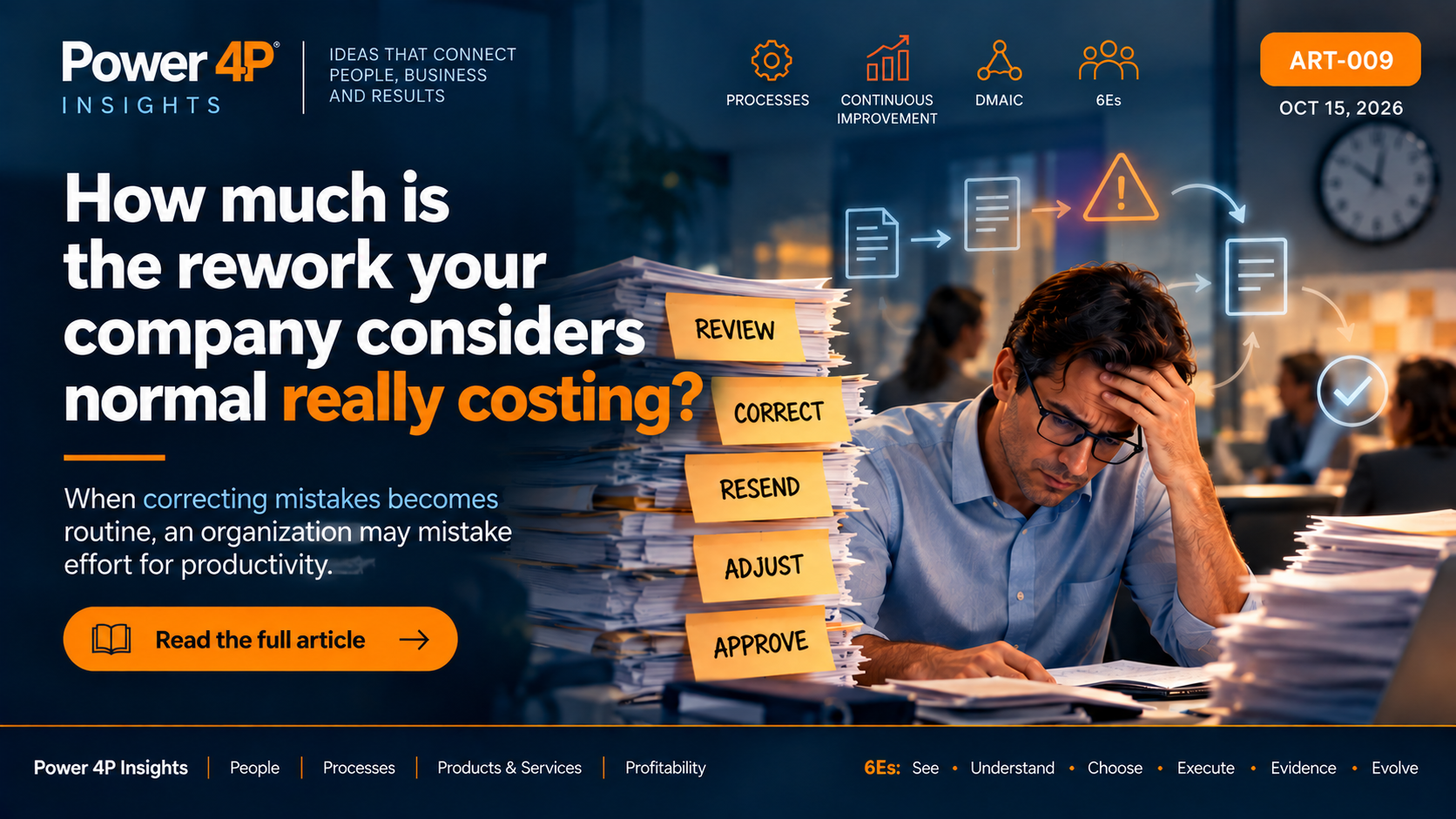
Some activities are performed twice or more before the expected result is achieved. Information is corrected before invoicing, an order returns for clarification, and a report must be rebuilt because the data is unreliable.
The cost that is difficult to see
Rework consumes labor hours, capacity, deadlines, and margin. These costs are often scattered across indicators rather than recorded as a separate expense.
An illustrative calculation
Consider a hypothetical example, not actual client data:
Monthly occurrences: 180.
Average time per occurrence: 35 minutes.
Monthly hours consumed: 105 hours.
Estimated hourly cost: BRL 60.
Monthly cost of time consumed: BRL 6,300.
Assuming the same conditions throughout the period:
3 months: BRL 18,900.
6 months: BRL 37,800.
12 months: BRL 75,600 and 1,260 hours consumed.
These figures estimate the cost of capacity absorbed by corrections, not necessarily additional cash expenditure. Delays, complaints, and missed opportunities are excluded.
How many corrections are needed before your team can call a delivery complete?
When performance indicators conceal waste
A team may meet its delivery targets while sustaining high levels of rework. The final output is measured, but the additional checks and corrections required to achieve it may remain invisible.
DMAIC: investigate before intervening
Define: identify the process, problem, stakeholders, and improvement target.
Measure: establish a baseline for frequency, duration, error types, and costs.
Analyze: validate root causes, using Pareto, fishbone diagrams, and the Five Whys where appropriate.
Improve: test and implement solutions that address verified causes.
Control: monitor results and prevent recurrence.
DMAIC does not begin with a solution. It begins with a well-defined problem and evidence to guide decisions.
The Power 4P 6Es
See (Enxergar) makes normalized rework visible.
Understand (Entender) examines causes and impacts.
Choose (Escolher) prioritizes evidence-based actions.
Execute (Executar) implements changes.
Evidence (Evidenciar) verifies results.
Evolve (Evoluir) embeds learning into daily operations.
The 6Es and DMAIC can complement one another: a structured improvement method within a broader organizational transformation journey.
The goal is not to correct mistakes faster
Reducing rework means designing processes that require fewer corrections, freeing capacity for activities that create value.