
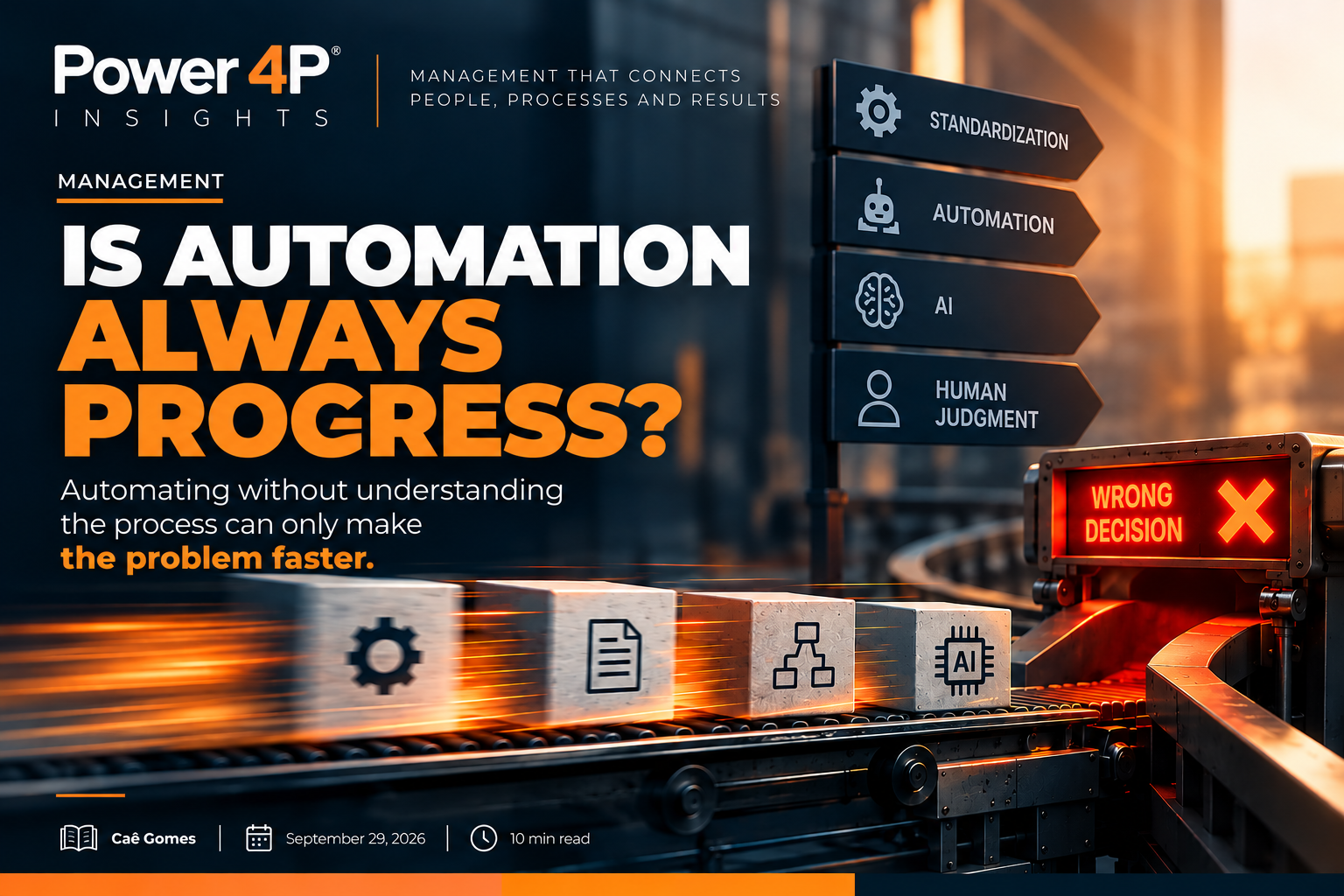
Automating the Process — or Automating the Problem?
A question has gained momentum with the advance of automation and, especially, artificial intelligence:
If an activity can be performed by technology, does it still make sense to keep it in human hands?
The question is legitimate.
But perhaps it starts in the wrong place.
Before deciding what to automate, there is another question:
Does the organization understand well enough what it intends to automate?
That difference can determine whether technology increases organizational capacity — or simply makes an existing problem happen faster.
The designed process and the process that actually happens
Processes rarely work exactly as they appear in flowcharts, procedures or systems.
In real operations, people know the exceptions.
They know whom to call.
They maintain parallel controls.
They anticipate problems.
They interpret situations that were not foreseen.
They create shortcuts.
In many cases, what appears to be process capability is actually people's ability to compensate for its limitations.
That does not necessarily mean they are performing the process incorrectly.
The deviation may contain information.
When someone creates a parallel spreadsheet, bypasses a step or always consults a particular person before making a decision, there is a signal there.
The management question should not only be:
“Why is the process not being followed?”
It may be more useful to ask:
“What did people have to learn, add or work around for this process to function?”
Because automating before understanding this difference can mean turning an operational weakness into an automated weakness.
Standardizing is not the same as automating
Standardization and automation often appear together in discussions about efficiency.
But they are not the same thing.
Standardizing means establishing a sufficiently consistent way to perform a given activity.
Automating means transferring part of its execution to technology.
A process can be standardized and continue to be performed by people.
It can also be partially automated.
Or there may be activities where automation simply does not generate enough benefit to justify cost, complexity or risk.
Therefore, the existence of a standard should not automatically lead to the conclusion that there is an automation opportunity.
Likewise, the technical possibility of automating something does not mean it should be automated.
The question is not only:
“Is it possible?”
We also need to ask:
“Does it make sense?”
Artificial intelligence has expanded this boundary
Traditional automation works particularly well when inputs, rules, outputs and exceptions can be sufficiently defined.
If a certain condition occurs, a certain action is executed.
Workflow tools, system integrations, RPA and automation platforms have greatly expanded this capability.
Artificial intelligence adds another layer.
It makes it possible to work with language, less structured information, pattern recognition and situations that do not need to be fully described in advance by a rigid sequence of rules.
This significantly expands what can receive technological support.
But it does not turn uncertainty into certainty.
Nor does it eliminate context, risk, consequence or responsibility.
AI can produce a plausible response to a new situation.
It can combine information and suggest alternatives even when it has never encountered exactly that scenario.
That is different from saying that every new situation can be delegated to it with the same level of confidence.
The further a situation is from known patterns, the less context is available, and the greater the consequences of a decision, the more important it becomes to assess how technology and human judgment should be combined.
What should remain human?
Perhaps that is not the right question either.
Because it suggests a permanent division:
on one side, machine tasks;
on the other, human tasks.
That boundary will continue to move.
Activities that required human intervention yesterday can be automated today.
Activities that today depend heavily on people may receive increasing levels of technological support.
A more useful discussion may therefore be:
How much of this activity can we delegate to technology without losing the context, judgment and responsibility required to produce a good decision?
In some situations, technology may perform practically the entire process.
In others, it may prepare information, identify patterns or recommend alternatives while a person decides.
There will also be situations in which human participation remains predominant.
Not because humans are, by definition, better at dealing with anything new.
People also interpret the present through experiences, references and patterns built in the past.
The difference appears, among other things, in the ability to perceive that the context itself has changed, seek information not yet available to the system, question assumptions, redefine the problem and consider organizational consequences that go beyond the isolated task.
And there is another dimension that should not disappear from the discussion:
responsibility.
A recommendation produced by technology does not eliminate the organization's need to define who is accountable for the consequences of that decision.
Automation is a management decision
This issue appeared very concretely in a recent conversation with someone working on the other side of this challenge: developing automation and artificial intelligence agents.
When discussing projects in organizations whose operations still need to be understood, a very practical difficulty emerged: before automating, it is necessary to discover how the work actually happens.
Not only how it is supposed to happen.
It is necessary to understand the process, its exceptions, the knowledge people add to execution and the decisions that depend on context.
The observation is interesting precisely because it comes from someone working with the technology.
It reveals that process mapping and automation are not on opposite sides of transformation.
The more technological capacity we have to automate, the more important it may become to understand what we are about to hand over to technology.
The tool can execute what was designed at enormous speed.
But speed, by itself, does not correct a flawed design.
Discussions about automation frequently begin with the tool.
Which platform should we use?
Which process should we automate?
Where should we apply artificial intelligence?
How much time will be saved?
These are important questions.
But perhaps they should come later.
Before them, we need to understand the work.
What actually happens?
Where is there repetition?
Where are the exceptions?
Which decisions depend on context?
What information is required?
What is the risk of a poor decision?
What are its consequences?
Who is accountable for it?
Only then does it make sense to choose how much to standardize, how much to automate, where to use artificial intelligence and where to preserve or reinforce human judgment.
Standardization, automation, AI and human judgment are not rungs on a ladder
There is a tempting representation:
first we standardize.
Then we automate.
When variability appears, we use artificial intelligence.
When something truly complex arises, we leave it to people.
It is a simple picture.
And precisely for that reason, it can be dangerous.
These capabilities do not necessarily form a ladder.
They can coexist within the same process.
One step may be rigidly standardized and automated.
Another may use AI to interpret information.
A third may require human validation.
And a fourth may remain essentially dependent on judgment.
The appropriate design depends on predictability, context, risk, consequence and responsibility.
Technology does not eliminate the need for management.
It increases the number of choices management needs to make.
See before automating
This is where the Power 4P Management Cycle helps organize the discussion.
SEE means observing the process that actually happens — not only the one that is documented.
UNDERSTAND requires understanding why deviations, exceptions, parallel controls and human decisions exist.
CHOOSE means consciously deciding what should be standardized, automated, supported by AI or remain under greater human judgment.
EXECUTE transforms that choice into a new work design.
EVIDENCE verifies whether the change actually increased capacity, quality, productivity or results — and what consequences it produced.
EVOLVE uses that evidence to continuously review the system itself.
Along this path, People, Processes, Products/Services and Profitability cease to be isolated dimensions.
Automation changes the process.
It changes people's work.
It can affect the experience or quality of the product and service.
And it needs to produce an economically justified relationship between investment, capacity, risk and results.
Automating more does not necessarily mean evolving more
Automation and artificial intelligence dramatically expand what organizations can do.
The point is not to reduce that possibility.
It is to use it with discernment.
Perhaps a technologically mature organization is not one that automates everything it is able to automate.
It may be one that understands its processes well enough to decide where technology increases capacity — and where context, supervision, judgment or human responsibility are still needed.
Because speed is capacity when we are moving in the right direction.
When we are not, speed only reduces the time needed to reach the wrong place.
So before asking how much we can automate, perhaps there is a more important question:
Do we understand well enough what we are about to accelerate?